Showing posts with label github. Show all posts

06 July 2024

Fixing a Memory Corruption bug in Python

For Omniverse we use Python for scripting. About a year and a half ago, we upgraded from Python 3.7 to Python 3.10. Shortly thereafter, we started seeing occasional memory corruption issues crop up, but it took a while to actually link the cause to Python.

A lot of the crashes that we were seeing involved very deep and complex Python stack traces in seemingly innocuous things: the garbage collector, releasing a reference, sometimes allocating new memory within Python. Since my team in the Omniverse group handles the plugin system, we manage the plugin that embeds Python into Omniverse, which means I was assigned all of these crashes for triage.

We do have some internal Python experts, and my team wasn't the tip of the spear on the 3.7 -> 3.10 upgrade (though we were involved). The nature of memory corruption means that crashes can happen in very random ways, since any call to acquire or free memory (which happens a LOT) may trigger a crash. So we had 20+ different stack traces that were considered to be part of the same memory corruption pathology. Curiously, this was only happening on Windows, and another clue was that quite often we would see an error in the log sometimes well before the crash occurred:

RuntimeError: <_overlapped.Overlapped object at 0xXXXXXXXXXXXXXXXX> still has pending operation at deallocation, the process may crash.

"Helpful!" I thought to myself sarcastically. Well, the process was in fact crashing, so this may be an indication as to what happening.

However, this crash was fairly low priority. It wasn't happening often per se, but it was annoying. I made a task to track all of the different automatically generated crash stack traces, and periodically tried to find someone who could look into it. Since it was Windows-only and rare, it never percolated up to the top of anyone's priority queue.

Months passed and I continued to be irritated when another new stack trace would pop up. Everyone, including me, was busier with higher priority tasks. Since no one else could be bothered to fix it, I eventually decided to take a crack at it.


"Overlapped" I/O?

Typically when you're writing a program and you want to do a network request, or reading a file, or any other sort of input/output the easiest thing to do is to stop everything and wait because you need the results before continuing. But in the world of 60+ FPS, stopping and waiting for even a few milliseconds can feel sluggish. We instead want to do things a-synchronously--have them happen in a background process and the program can do other things while waiting. One way of doing this is through parallelization, that is, using a separate thread or CPU to do work, but this can also be messy. Also, Windows is old and computers used to just have one CPU, so a long time ago Windows started doing a-synchronicity through concurrency and the Operating System would handle interleaving all of the requests. "Overlapped" I/O is how Windows started doing that: multiple I/O operations could be done at a time, hence they overlap each other.

The problem is, it's pretty complicated. And even more so in an environment like Python where implementation requires both C code and Python code.


Reproducing the problem

The first step was to try to reduce the problem to a minimum so that it was easier to debug. I also knew that we started having this problem when we moved from Python 3.7 to 3.10, so I looked at the changes to see what might be different. I noticed this in the "what's new in Python 3.8" article:
On Windows, the default event loop is now ProactorEventLoop. (Contributed by Victor Stinner in bpo-34687.)

It turns out that Windows and Linux asyncio event loops are implemented quite differently, which makes sense because Asynchronous IO works quite differently on Windows and Linux. With Python 3.8, asyncio now used Overlapped IO by default through the Proactor event loop.

Omniverse was also doing something different from most Python applications: constantly stopping and re-starting the event loop. See, in most Python applications the program hands control to asyncio until the program finishes; asyncio then dispatches everything that the application does. Since Omniverse uses embedded Python, we still have a graphical application that needs to run, so each frame of the graphical application we would just run the asyncio event loop for one "tick" and then stop it.

I wrote a simple app that emulated that behavior, but I couldn't get it to crash, so that wasn't enough to do it. We had a sample case that could produce the Overlapped error message typically within 5 minutes (which is an eternity when you're waiting for it), so I looked at what it was doing. After much debugging I found another clue: other threads were calling call_soon_threadsafe on the event loop. I added that to my test program. BINGO. This program had an 80% chance to print the error message within 60 seconds:

This program starts a thread that pings away scheduling a dummy function to run on the next loop iteration. It's real purpose is to send a wakeup signal to the event loop. The main thread just constantly does our stop/run idiom like Omniverse does so it doesn't have to hand control to the event loop permanently.


But does it corrupt memory?

The error message comes from the implementation of _overlapped, which is done in C and acts as a bridge between Python code for the asyncio event loop and the Windows API call to manage overlapped I/O. Let's look at what happens before that.

When the run_forever call is cleaning up it tries to cancel the "_self_reading_future":

Which in turn calls into the C code for _overlapped and invokes a Windows API function called CancelIoEx:


Then the run_forever function unregisters the 'overlapped' object (ov) and sets the future to None, effectively destroying the object.

This is where the danger arises! The overlapped structure (managed by the overlapped Python object) has been passed to the Windows API when an IO operation was requested (in this case it's for the socketpair used to notify the event loop for other threads) and cannot be deallocated until Windows reports that it's done with it!

The deallocation function attempts to check this, and reports the error message if Windows isn't done with it. But then goes on to deallocate the structure anyways, which can lead to memory corruption!


While not ideal, a better alternative might be to report the error and leak the OVERLAPPED structure so that a crash won't occur. But the best alternative is to see if we can fix the problem.

With a reproducible case and an understanding of what was going on, I filed a Python issue.


Can we fix it?

I put the initial diagnosis into the Python issue: CancelIoEx is being properly called, returns TRUE meaning that Windows requested the cancellation (NOT that it was cancelled yet!), but the deallocation function sees that the overlapped I/O hasn't yet completed. It tries to call CancelIoEx again (this always fails with ERROR_NOT_FOUND since the previous cancel request succeeded), and then calls GetOverlappedResult (note that wait=false because the second CancelIoEx attempt fails), which will also fail with ERROR_IO_PENDING. As a test I tried changing it to wait, but this just caused a hang.

What gives? Originally I though this was a bug in Windows and handling Overlapped I/O, but then I tried something else. Not only is this system using Overlapped I/O, it's using another complex Windows-ism: I/O Completion Ports. This system is a way to group multiple I/O requests together, so that instead of having to check myriad different requests, you check one "completion port" to find out when any of your requests finish. What if the cancelled I/O request is stuck in the I/O completion port? Instead of waiting on GetOverlappedResult, maybe I need to read the request from GetQueuedCompletionStatus.

BINGO.

Turns out that was the case: it really depends on where within the labyrinthine Windows I/O ecosystem the I/O request ended up before the cancel request happened.

So now we could make an "official" fix recommendation. Generally large projects like Python desire fix recommendations from outsiders like me to be as simple and elegant as possible. Which meant that I would have better luck without completely trying to change how their Overlapped I/O worked. Since all we needed to do was make sure that GetQueuedCompletionStatus was called on our _overlapped object again, that gave us a goal. GetQueuedCompletionStatus was actually called every time the event loop ran, and it already cleaned up finished _overlapped objects once they completed. All we need to do is only allow cleanup after canceling if the I/O was complete, otherwise it would get cleaned up automatically during the next event loop iteration.

So that just meant changing the line


to


Done and dusted!

Of course, for the official fix I added a unit test and a bunch of comments since Overlapped I/O and I/O Completion Ports are frustratingly touchy.

As a bonus, Guido van Rossum (creator of Python) commented positively on the fix, and eventually we got the fix merged back as far as Python 3.8--the oldest supported version (for security fixes), but also the first version where the ProactorEventLoop became the default.

30 June 2014

By the Library of Thor!

I recently uploaded to github a C++ template library called Thor, which is something that I've been playing around with. It's really just a way for me to write some crazy template code--a creative outlet if you will. This blog post is meant to show off some of the things that I'm proud of in Thor. The name Thor came in part because of inspiration from Andrei Alexandrescu's template library Loki and his book Modern C++ Design (an excellent advanced C++ book).

Some things in my Thor library are just me implementing things in the way I would if I had full control, and some are a slightly different take on popular concepts. Some things are already outmoded based on offerings in C++11 (especially in terms of atomic support), but are included for posterity.

I apologize that the code samples are images (Blogger currently doesn't do well with template syntax), but generally a link is provided to the code on github.

Containers

The C++ standard library includes several standard, well-known and well-documented containers, however these containers don't often allow for much customization. For instance, std::vector (up until the C++11 standard) had no obvious means to free memory (C++11 adds the shrink_to_fit() function). Although not technically correct, I'll refer to the C++ standard library as STL below for brevity's sake.

thor::basic_string

Thor's string class works very similarly to std::string and std::wstring with a few changes. First, the strings are atomically reference counted, so the underlying string data is shared when possible. Secondly, a template parameter can be specified to pre-reserve (as part of the basic_string instance, not a separate heap allocation) space for the string. The default of zero is a fully dynamic string, but if you need a quick string on the stack and don't want to allocate anything from the heap, it is easily done with the addition of a size template paramter:

Furthermore, in addition the STL constructors for basic_string, additional options are available for printf-style formatting and literal strings (that don't require copying or allocation):

The printf-style formatting is also supported for append, insert, replace and assign variants.

Thor's string also supports conversion between UTF-8 and "wide" (wchar_t). If wchar_t is 32-bits, then the conversion will be between UTF-8 and UTF-32, however the more likely case is that wchar_t is 16-bits, in which case the conversion will be between UTF-8 and UTF-16, complete with support for UTF-16 surrogate pairs.

thor::list

In general node-based STL containers (such as std::list) will allocate a 'dead node' or a terminator node from the heap as soon as they're constructed (even default constructed). Usually this terminator node will include space for the 'T' stored type, although that space will never be used and therefore wastes space. I frown upon the fact that wasted space is allocated from the slower heap for such a simple operation as default constructing a list.

Consider Thor's list class. Instead of heap-allocating a terminator node, the head/tail pointers for the list class use a list_node_base and the address of the list_node_base is used as the terminator. Thus, the terminator (used by the end() iterator) is implemented as such:

This has the advantage of not requiring a heap allocation for the terminator node while still allowing for simple reverse iteration and no need for null-pointer checking at head/tail. However, there are two disadvantages. The first is that any accidental writes to the end() iterator (which is completely invalid anyways) may cause memory corruption. This can be prevented in checked/debug builds with asserts when trying to dereference the end() iterator. The second is that swap semantics require slightly more finesse (although these are more complicated in Thor for another reason explained below). In std::list the swap() function must only exchange pointers and counts between two lists--since the terminator node is allocated on the heap it is not tied to either list and is automatically part of the swap. However, since Thor's list essentially has a local terminator node as part of the instance, care must be taken to fix up the terminators during swap:

Notice that the swap function handles a concept of shareable. This is because of another enhancement of Thor's containers. Essentially, space for a certain number of items can be pre-allocated along with the container, similarly to the string class mentioned above. For instance, thor::list<T,5> specifies that no heap allocations must occur for the first five list entries. Fortunately, thor::list<T,5> inherits from thor::list<T> so that it can be used anywhere where a list is required. However, it also means that the problem of swap() now must handle pre-allocated nodes. It is less efficient to swap() a list with pre-allocated nodes as this requires the nodes be converted to heap allocated nodes.

There are many other extensions to all of the containers, yet they all try to remain true to the C++ standard library specification.

thor::hash_map (et al)

The thor::hashtable class (which forms the basis of hash_map, hash_set and the multi- versions of each) has a noteworthy feature: a policy class that controls how the stored values are organized into buckets. The options are a power-of-two system that is very fast by using bitwise masks instead of divide/mod instructions (although this method can be terrible for pointers as keys as they typically are multiples of 4 or 8 and the bucket strategy loses efficiency leading to collisions), or a more traditional (and slower yet less collision-prone) prime-number strategy.

The C++ standard library hash containers are undefined order containers. This means that the order in which you insert items is not necessarily the same order in which you would iterate over the items. However, thor's hash containers are a fusion of a list and a hashtable, which allows for a defined iteration order as well as amortized O(1) lookup time. This does require a slight change to how iteration starts: the begin() function defaults to 'list' iteration mode but can be changed to 'hash' iteration mode, whereas find() operations default to 'hash' iteration mode.

Embedded Containers

For std::list (or thor::list for that matter), the 'T' type that you're storing in the container is contained within a node that tracks other information for the container. If you had a list of pointers to objects in the heap, then the objects were allocated and the list container must allocate a small node to store the pointer. This is wasteful. The embedded containers can alleviate this by having the node tracking information as part of the object that is being stored. For instance, the 'T' type stored in a thor::embedded_list must contain an embedded_list_link member and the member is given as a template parameter to thor::embedded_list.

Atomic integer/pointer

The thor::atomic_integer system is similar to C++11's atomic wrapper, so while not completely necessary it was a fun exercise to write. The real meat of how it works is based in the platform-specific interlocked system (the Windows version is interlocked_win). This uses template specialization to handle one-, two-, four- and eight-byte integers. By using intrinsics, these atomic_integers actually compile down to very few inline instructions for most operations. Consider how declaring interlocked works on a platform with a 32-bit integer. First, some magic happens based on how the non-specialized interlocked class is declared. There is a second template parameter that is required, but defaults to sizeof(T):

The template parameter T_SIZE defaults to 4 for int, which causes a specialization to be selected:

This specialization uses the correct functions/intrinsics for the numeric type that we're wrapping in atomic_integer. This allows atomic_integer to do the correct operation based on size of the integer parameter:

Memory Alignment

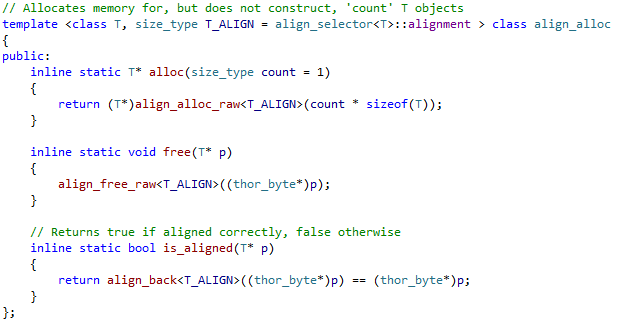
Another place where Thor uses template specialization is with memory alignment. All of the containers do memory allocation through Thor's memory functions. There is a simple class called the align_selector:

This class's only job is to determine if an object can use system-guaranteed alignment or not (most objects can). If the system alignment will suffice, alignment_selector::alignment will be zero. The align_alloc class uses the align_selector as a default template parameter to select the proper specialization for the alignment:

The system default alignment just allocates raw bytes:

But the default version that handles non-default alignments will over-allocate and offset:

Arguably, this version could use _aligned_malloc or memalign or similar, but by using new[] an application may still override new and use their own memory manager if so desired.

There is a lot more to the Thor library. Take a look at it on github and let me know what you think.

04 February 2014

Githubbing

I just created a repository on github.

https://github.com/jkriegshauser/fastjson

For a while I've been writing a json parser (fully RFC-4627 compliant) similar in interface to rapidxml as a fun way to write some simple code that ended up being fairly complex. I mean, there's a good bit of template partial specialization in there, exception/non-exception handling, Unicode support, unit-testing, etc.

It even figures out if you've given it UTF-8, UTF-16 or UTF-32 and whether the endianness matches your machine or not.

Yeah, so that's how I have fun. Enjoy, universe!